

Inside ISIS-Somalia's Shadow Economy: From Gold Mines to Digital Hawala
|
05 September 2025 12:10
 0
0 - Visits: 10086
-

- Share


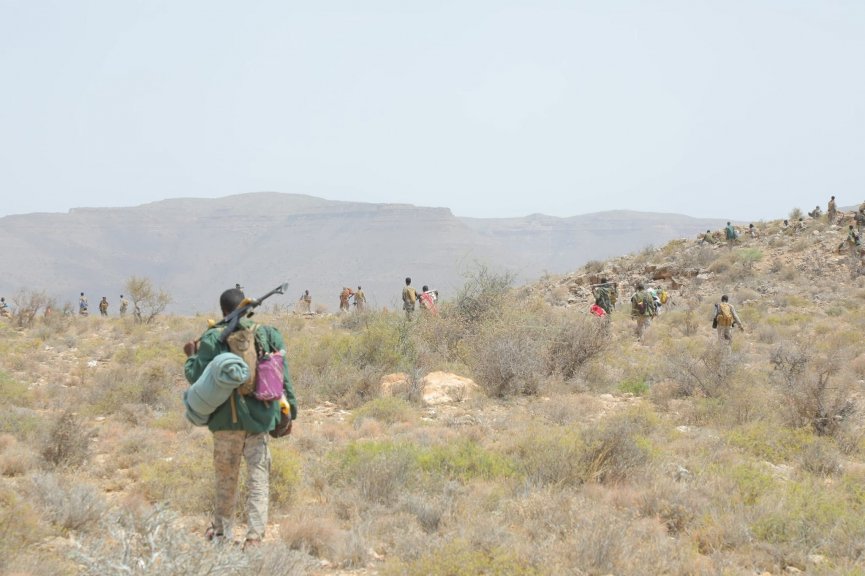
GAROWE, Somalia (HORN OBSERVER) - When Puntland's counter-terrorism units stormed ISIS-Somalia hideouts in the caves of the Cal Miskaad mountains—after nearly ten months of fighting—they uncovered more than just weapons and foreign fighters smuggled into the country.

The raids revealed how ISIS-Somalia had built a vast financial empire.
Investigators found evidence of the group’s involvement in gold mining, illicit arms trade including procurement of suicide drones, real estate deals, livestock markets, fuel distribution, export and import of food, and even banking operations. These ventures provided ISIS-Somalia with a steady flow of income, transforming it into one of ISIS’s most significant affiliates in Africa.
The U.S. government now considers ISIS-Somalia a primary revenue generator for ISIS’s global networks.
But there is one area that has been often overlooked. Somalia’s rapidly expanding hawala system, fueled by mobile money and growing internet access, has long operated outside government regulation. While convenient for millions of ordinary Somalis, this system has also been exploited by criminals and terrorist financiers.
The 2025 U.S. State Department INCSR report warned that informal money transfer services are widely used across East Africa, including by refugees and ethnic Somali residents in Kenya. It cautioned that such systems provide criminals with "swift, anonymous transfer capability.”
In August, the National Bank of Ethiopia (NBE) announced a crackdown on illegal hawala operations, blacklisting four U.S.-based Somali-owned remittance firms in cooperation with U.S. authorities. The move aimed to dismantle unregulated financial networks suspected of money laundering and undermining formal banking channels.
The Sifalo Pay Mystery
During their investigation, Puntland officers discovered that ISIS-Somalia financiers in Somalia, Djibouti, Ethiopia, and even Europe had been instructed to use a little-known hawala app called Sifalo Pay. Intelligence sources suggest the group laundered millions of dollars through this platform in less than six months.
Though Sifalo Pay claims to be headquartered in Somalia and incorporated in the U.S., its operations remain murky. On its website, it advertises itself as a "multi-payment platform enabling businesses to accept mobile money and card payments".
However, a former employee of Premier Bank Somalia told this publication that the app was directly linked to the bank, which has ties to the Somali government.
"The Premier Bank and certain businessmen were part of this app,” the former employee—speaking on condition of anonymity—told this publication. "But staff were instructed never to disclose Premier Bank’s involvement.”
Premier Bank is based in Mogadishu, while Sifalo Pay lists its "headquarters” in Hargeisa, Somaliland.
Attempts to contact Sifalo Pay through its listed phone numbers and emails went unanswered.
ISIS-Somalia’s Financial Reach
The Islamic State emerged in Somalia in late 2015, when defecting al-Shabaab commanders pledged allegiance to Abu Bakr al-Baghdadi and established a foothold in Puntland’s mountains.
In December last year, Puntland forces launched a sweeping operation to eradicate the group from the mountainous area. Since its start, the operation has killed hundreds of militants and arrested dozens, including foreign fighters according to Puntland security officials.
Since its start, the Puntland operation killed hundreds of terrorists and arrested dozens, including foreign fighters.
"The group calls Cal Miskaad its Somalia headquarters, and evidence we have seen confirms this,” says Officer Mohamed, who took part in the operation.
Days ago, the army discovered a large stone banner painted with Arabic text reading, ‘Welcome to the HQ of the Home of Paradise.’ A similar banner was found in February at Sheebaab village, describing a ‘Somalia State’ and marking Puntland as the base of ISIS’s African branch.
According to a 2023 UN report, ISIS-Somalia raises at least $100,000 per month through extortion and illicit taxation, with some of these funds transferred to other ISIS affiliates via the al-Karrar office. Another estimate suggested the group generated $2 million in just the first half of 2022.
ISIS-Somalia’s income sources are diverse. The U.S Government believes ISIS generates funds from taxation and extortion of businesses and farmers, money laundering and illicit financial transfers, kidnapping for ransom, arms trafficking, piracy and illegal fishing, recruitment and facilitation of foreign fighters, donations, online fundraising, and cryptocurrency transactions.
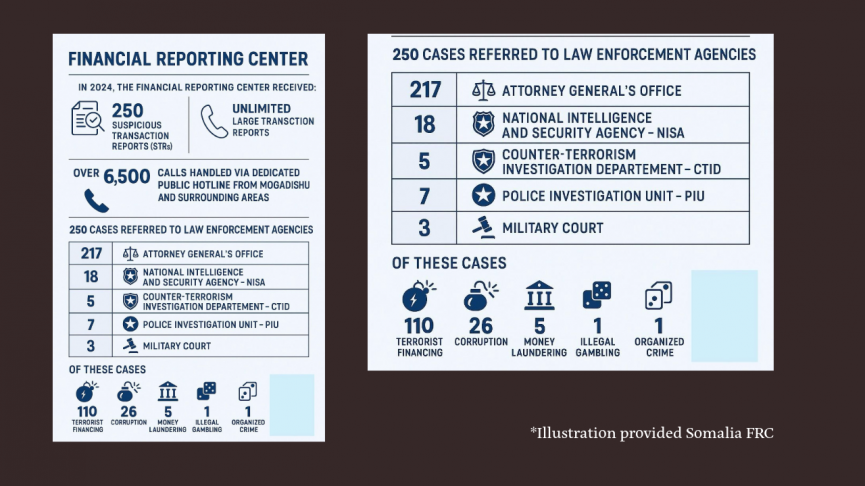
The Somalia Financial Reporting Center (FRC) reported 250 cases of suspicious money transfers in 2024. Absisalam Ali, senior AML officer at the FRC, said these "included 110 cases related to terrorist financing, 26 cases of corruption, 5 cases of money laundering, 1 case of illegal gambling, and 1 case of organized crime.”
But analysts and politicians argue these figures represent only a fraction of the true scale.
Opposition leader and MP Abdirahman Abdishakur Warsame recently told local media that over 120 suspicious cash transfers were made from Somalia to Kenya in 2024 alone—some involving Somali security officers. He noted that much of this money was invested in real estate in Kenya, raising questions about whether ISIS-Somalia assets are hidden in those holdings.
ISIS-Somalia’s funds are not confined to Somali borders. Intelligence sources say the group disperses money across Kenya, the Democratic Republic of Congo, and South Africa—where large Somali-owned businesses operate.
"ISIS-Somalia doesn’t only rely on weapons and explosives experts hiding in caves,” one intelligence officer explained. "They have skilled IT specialists and financial consultants—people sitting in coffee shops in Mogadishu, Nairobi, Johannesburg, even Minnesota.”
The U.S. Rewards for Justice Program recently announced up to $10 million for information that could disrupt ISIS’s financial networks. Yet with the group’s reliance on unregulated hawala systems and business fronts spanning multiple countries, tracking and dismantling these operations remains a formidable challenge.

- Popular
- Rated
- Commented


04/11/2021 - 11:05:02

28/05/2024 - 15:44:10


18/08/2025 - 17:22:07

01/03/2021 - 09:00:37



Opinions
16/09/2026 - 16:11:57
15/09/2026 - 16:56:43
Politics
06/10/2026 - 18:48:48
06/10/2026 - 15:14:30
02/10/2026 - 17:35:54
Terror Watch
06/10/2026 - 21:41:19
06/10/2026 - 21:03:29
29/09/2026 - 14:38:38
Press Releases
05/10/2026 - 19:10:20
30/09/2026 - 22:54:31




Inside ISIS-Somalia's Shadow Economy: From Gold Mines to Digital Hawala
GAROWE, Somalia (HORN OBSERVER) - When Puntland's counter-terrorism units stormed ISIS-Somalia hideouts in the caves of the Cal Miskaad mountains—after nearly ten months of fighting—they uncovered more than just weapons and foreign f