

Somalia: From Transitional Federalism to a Defined Federal Order: Constitutional Design Choices in Amended Chapter 5
 0
0 - Visits: 17172
-

- Share
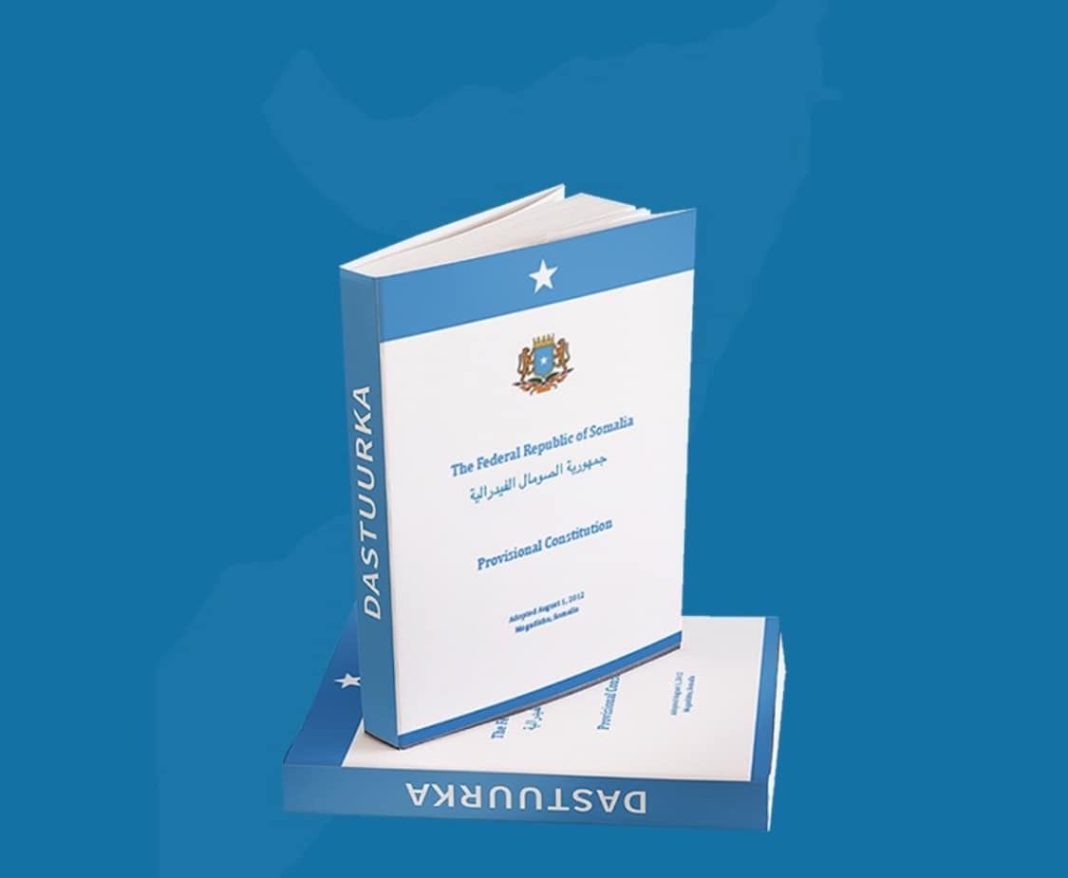

The 2012 Provisional Constitution ("PC”) declared Somalia a federal state. Chapter 1 established the federal character of the Republic and recognized two levels of government, while Chapter 5 sought to operationalize that declaration by outlining a framework for devolution. Yet the PC stopped short of fully allocating authority. Only a limited set of federal powers was specified, leaving most competences to negotiation between the Federal Government ("FGS”) and the Federal Member States ("FMSs”). The status of the capital was similarly deferred. In practice, these unresolved questions were not settled through cooperation or gradual constitutional development; instead, the resulting ambiguities became persistent sources of institutional conflict, contributing to recurring political confrontation and governance paralysis.
The January 2026 constitutional amendments seek to resolve these allocations. The amended Chapter 5 is designed as a comprehensive constitutional settlement. It spans nineteen articles, from Article 61 to Article 79, and establishes a comprehensive federal architecture governing vertical structure, power allocation, residual authority, delegation, intervention, constitutional harmonization, and intergovernmental relations.The amendments reflect a shift from a provisional to a defined federal order.
The change begins with the vertical structure of the state. Under the original Article 48, Somalia was constitutionally organized as a two-tier federation, consisting of the FGS and its FMSs, with local government embedded within state structures rather than recognized as an independent constitutional tier. The amendment to former Article 48, now recast as Article 61, redraws the vertical separation of powers by establishing three levels of government: the FGS, the FMSs, and the Local Governments ("LGs”). Under the new structure, the LGs are no longer derivative administrative units. They are constitutionally recognized actors within the federal structure, with Article 64 setting out the general principles governing relations among the three levels, and Articles 65 and 66 operationalizing those principles through duties of cooperation and intergovernmental agreements.Whether this elevation of LGs is fully consistent with the underlying federal bargain and the constitutional process through which it was adopted raises important constitutional questions.
The amended Chapter 5 also constitutionalizes the logic of state formation. Article 62 frames FMS formation as a constitutionally defined process. Under the PC, state formation occurred within a transitional framework that did not prescribe detailed constitutional conditions for the existence or consolidation of FMSs. Article 62 narrows that openness by embedding state formation requirements directly in the constitutional text. Statehood is no longer treated as a transitional or politically contingent outcome but as a status defined by constitutional criteria.
The amended Chapter 5 also reshapes internal state governance. Articles 68 and 69 introduce constitutionally mandated state-level institutions that link FMSs directly into federal coordination and oversight frameworks. Unlike the PC, which left the internal organization of state governments to state constitutions under Article 120, the new provisions embed specific institutional arrangements within the federal constitutional text itself. As a result, state governments are no longer defined solely by their own constitutions but are required to operate through federally prescribed structures as part of the national system. This marks a shift from state self-organization toward constitutionally standardized state participation.Whether this reconfiguration of state institutions aligns with, or departs from, the original federal bargain is a significant constitutional question.
Although the amendments elevate LGs to constitutional status, the text is largely silent on the institutional mechanisms through which that autonomy is to be exercised. Unlike the FGS and the FMSs, LGs are not endowed with constitutions or legislative bodies capable of independently defining policy or law. Their authority is therefore exercised primarily through implementation and administration rather than norm-setting. In practice, LGs are likely to operate within frameworks defined by federal or state legislation, making them susceptible to direction by higher levels of government depending on how fiscal control, supervision, and delegation are applied.
This structural vulnerability is accentuated in areas of shared competence. While LGs are constitutionally assigned exclusive functions under Schedule 2D and may implement nationally defined frameworks, the amended Chapter 5 does not provide LGs with a role in federal or state norm-setting processes. Their participation is therefore administrative rather than legislative, reinforcing an asymmetry in which LG authority is exercised within parameters set by higher levels of government.
Whether the introduction of a third tier strengthens subsidiarity or instead creates new avenues for undermining the federal bargain will depend on how fiscal, regulatory, and supervisory mechanisms operate in practice across the FGS, the FMSs, and the LGs. What is clear from the text is that the three-tiered federation set out in the amended Chapter 5 is more complex than the arrangement contemplated in the PC, with implications for how authority, coordination, and accountability operate across levels of government.
The most consequential transformation lies in the allocation of powers. The original Article 54 left the distribution of political and economic powers largely to negotiation between the FGS and the FMSs, apart from four core federal competences. That provision reflected a form of transitional federalism in which the final contours of authority remained unsettled. The amended Chapter 5 settles those allocations by replacing negotiated competence with enumerated powers, structured shared competences, and defined rules for delegation and intervention.
Article 70 assigns exclusive federal powers in Schedule 2A. Article 71 establishes shared powers in Schedule 2B, exercised concurrently by the FGS and the FMSs, with LG implementation where nationally defined frameworks apply. Article 72 enumerates exclusive FMS powers in Schedule 2C, exercised independently of the FGS except where the Constitution expressly provides otherwise. Article 73 defines exclusive LG powers in Schedule 2D, exercised autonomously within their constitutional sphere.
A further structural consequence of this design is that the allocation of competences is constitutionally entrenched through the schedules themselves. By incorporating Schedules 2A–2D into the constitutional text, the amendments convert functional power allocation from a framework subject to political adjustment into a fixed constitutional settlement. Changes to the distribution of powers therefore require constitutional amendment rather than ordinary political agreement, reducing interpretive and institutional flexibility.
Residual powers are addressed separately. Article 74 provides that powers not listed in the schedules do not default to either the FGS or the FMSs but must be resolved through agreement. Allocation is therefore treated as complete, with negotiation confined to a defined residual space rather than serving as the organizing principle of the system.
The new structure also shapes the operation of shared powers. Under Article 71, although competences are described as shared, authority over policy, legislation, standards, and oversight rests with the FGS, while implementation lies with the FMSs.The resulting model is not symmetrical concurrency but a form of administrative federalism, in which federal norm-setting is constitutionally privileged and subnational actors function primarily as implementing authorities. The architecture combines federal norm-setting with subnational execution, within a constitutional framework.
The amendments also constitutionalize delegation through Article 75. The FGS may delegate its exclusive powers to the FMSs with parliamentary approval; the FMSs may delegate their exclusive powers to the FGS with approval of their assemblies; and LGs may delegate authority upward to the stateswithout an expressly specified legislative approval mechanism at the local level. Authority is therefore transferable only through formally prescribed constitutional consent at the federal and state levels, while delegation by local governments is permitted without an expressly specified approval mechanism in the constitutional text. By structuring delegation in this way, the Constitution regulates how subnational authority may be transferred and reassigned, altering the mechanics through which state autonomy operates.
The amendments also address the relationship between the Federal Constitution and state constitutions. Article 67 requires FMSs to ensure that their constitutions are consistent with the Federal Constitution. This marks a departure from the earlier provisional approach, under which state constitutional variation was tolerated as part of an unsettled federal order. The new text does not frame alignment as an open-ended or negotiated process; it treats constitutional consistency as a requirement of the federal system itself. While the provision does not dictate the internal structure of state governments, it narrows the constitutional space within which state constitutional autonomy may operate.
The most revealing change lies in the new intervention framework. Article 76 authorizes federal intervention in a state where territorial integrity, national security, independence, or a severe breakdown is at risk. Article 77 establishes consultation requirements and emergency procedures. Article 78 limits intervention to measures that are temporary and strictly necessary. Article 79 subjects any intervention to review by the Upper House within fourteen days. Crisis management, previously handled through political discretion, is now constitutionally codified. Intervention is neither presumed nor open-ended; it is defined, constrained, and subject to review. How these powers are triggered, interpreted, and coordinated with shared competences and delegated authority will determine whether intervention operates as a stabilizing safeguard or becomes a recurring source of interference and dispute.
The treatment of the capital further illustrates the shift from provisional ambiguity to constitutional specification. Under the PC, the status of the capital was deferred and left to political practice. The amended Chapter 5 addresses this through Article 63, which limits the capital’s status to two constitutionally prescribed options. First, the capital may be constituted as a Federal Capital Region under the authority of the FGS and may not form part of any FMS. Under this option, its governance must be regulated by a specific federal law providing for democratic self-government, and residents must retain the right to elect representatives to both Houses of the Federal Parliament. Alternatively, the capital may be constituted as a FMS with status and rights equivalent to those of other FMSs and may not merge with or form part of any other state. In either case, the Constitution fixes the institutional form in advance and preserves the political rights of residents. What was previously unresolved is thus converted into a bounded constitutional choice, with permissible outcomes defined by the constitutional text itself.
Read as a whole, the amended Chapter 5replaces the provisional federal arrangement with a fixed constitutional allocation. It establishes a three-tier structure, enumerates competences through detailed schedules, regulates residual powers under Article 74, formalizes delegation in Article 75, requires constitutional consistency between federal and state constitutions under Article 67, codifies intervention in Articles 76–79, and prescribes the capital’s status in Article 63. Authority is distributed through specific functional lists rather than general principles, narrowing interpretive discretion while simultaneously multiplying and blurring jurisdictional boundaries.
The most critical issues lie in the design and operation of shared competences, constitutional harmonization, and residual authority. Article 71 assigns policy-setting, legislative authority, standards, and oversight to the FGS, while implementation rests with the FMSs, embedding vertical interdependence at the center of the system. Article 67 reinforces this interdependence by requiring state constitutions to conform to the federal constitutional framework, potentially reopening settled state-level arrangements. Article 74 completes the structure by providing that powers not enumerated in the schedules do not default to any level of government but must be resolved through agreement.Where coordination mechanisms are weak or institutional trust is low, these shared and harmonized domains are likely to generate disputes over compliance, encroachment, and intervention. The stability of the revised order will therefore depend less on exclusive allocations than on how interdependencies are managed in practice.
About the Author:
Bashir M. Sheikh Ali, J.D., Ph.D.is a Somali-American lawyer based in Nairobi. The views expressed in this analysis are his own and do not reflect those of any organization with which he may be affiliated. He can be reached at [email protected].

- Popular
- Rated
- Commented


04/11/2021 - 11:05:02


28/05/2024 - 15:44:10




18/08/2025 - 17:22:07

01/03/2021 - 09:00:37



Opinions

16/09/2026 - 16:11:57


15/09/2026 - 16:56:43
Politics

15/09/2026 - 20:46:55
15/09/2026 - 16:56:43
Terror Watch

15/09/2026 - 21:02:13

14/09/2026 - 09:39:33

14/09/2026 - 09:23:32
Press Releases

20/09/2026 - 13:43:07

20/09/2026 - 13:41:07





Somalia: From Transitional Federalism to a Defined Federal Order: Constitutional Design Choices in Amended Chapter 5
This is the first in a series of essays examining Somalia's proposed constitutional amendments and their implications for governance. This essay focuses on the institutional architecture created by the amended Chapter 5 and provides an overview