

UN OCHA: DR Congo: Why aid isn't reaching people
 0
0 - Visits: 3871
-

- Share
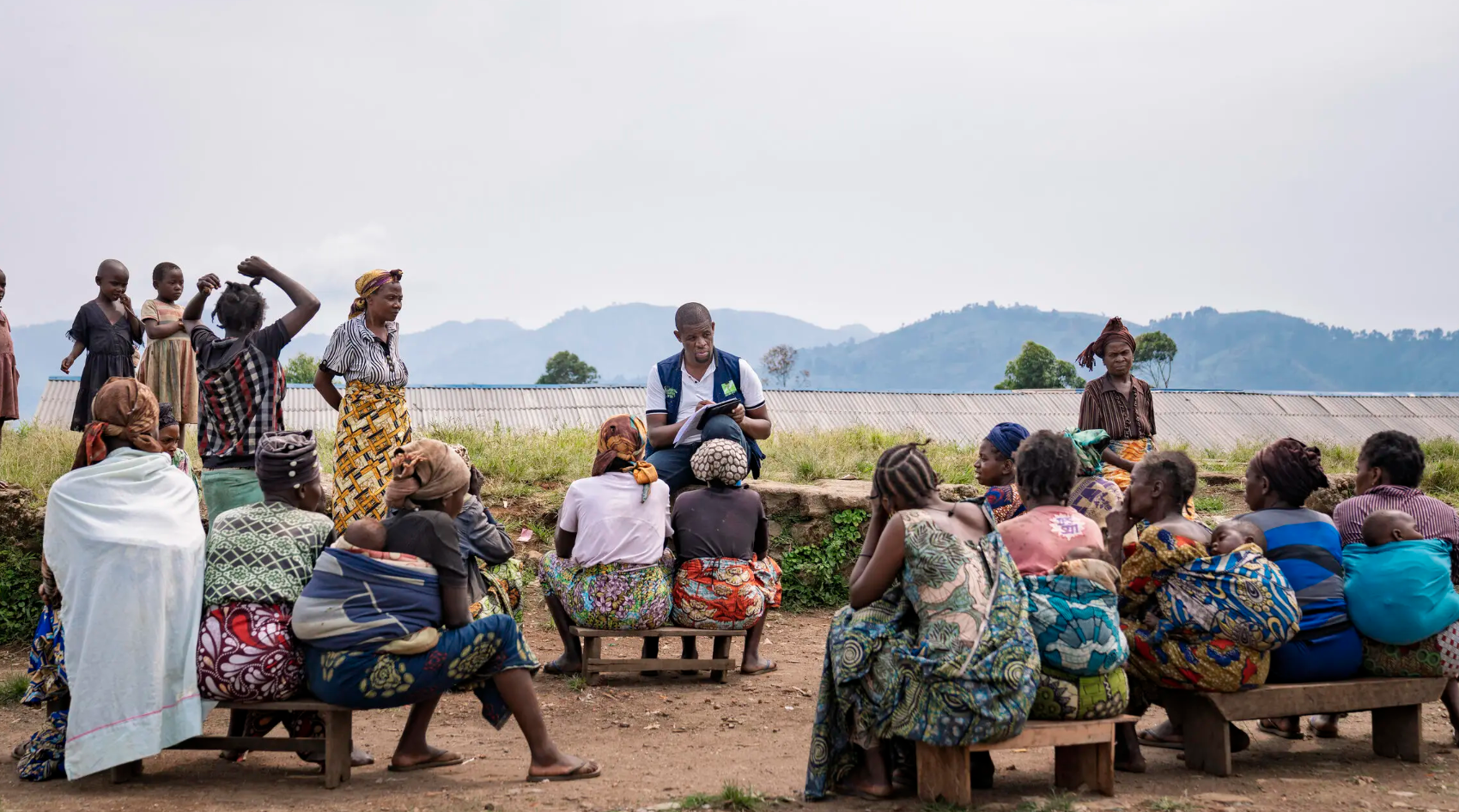

Step inside this wooden shed and the dark grabs hold of you. Light barely pushes through the two small doors, and a few wooden windows are cracked open just so. Then, little by little, the shapes appear. Sleeping mats, bundles of clothes, pots and jerrycans stacked beside their owners. Dry leaves, spread over the bare ground, serve as beds. The air is stifling, heavy with woodsmoke.
Once the hall of a local church – about 50 square metres – now shelters more than 300 people. The church is in Nyabiondo village, in the east of the Democratic Republic of the Congo (DRC).
Among them is young Béatrice Maniraguha, a mother of three. She has lived with a disability in her right leg for more than two years, and she moves with the aid of crutches. In September 2025, when armed clashes broke out in her village, she had to flee. "There was heavy gunfire. My husband, my children and I left everything and fled towards a safer place, without knowing where we were going,” she recalls. The escape was a two-day ordeal through open bush. "When my hands could no longer hold the crutches, I crawled to keep moving forward.”
The endless exodus
Since June 2025, Nyabiondo has taken in more than 30,000 displaced people fleeing violence in the surrounding villages.
Every day, new families arrive, overwhelming a capacity that was already stretched past its limit. However, reaching a safer place does not end the hardship.
"Life is hard here. We sleep on bare ground, we struggle to find food and water. We don’t even have utensils,” Béatrice confides.
A few kilometres away, in Masisi Centre, Sifa Hitimana, is living through a similar tragedy. Sheltering in a school with her six children, she is one of the 80,000 displaced people in the area, as of 31 May 2026.
Her husband, who had gone to look for a job in a nearby mining village, died in a landslide in February 2026. Two months later, Sifa gave birth to twins in that same classroom, the one that serves as a school by day and a shelter by night. "I depend on the goodwill of my neighbours to feed my children, because I can’t go out and leave my babies alone,” she explains.
Not long ago, she had to sell a tarpaulin, handed out by humanitarian workers to build a shelter, to buy food to feed her children.
Obstacles that feed each other
Humanitarian organizations are working on the ground; funds are being raised. So why do Béatrice and Sifa, like tens of thousands of others, still live in complete destitution? The answer lies in systemic obstacles that reinforce one another.
A crippling shortage of funding
The first problem is simple and devastating: there is not enough money. The organizations on the ground have only limited resources, in part because of recent budget cuts.
Although the humanitarian community had received, by June 2026, close to half of the funding it had appealed for this year, the funding gap of more than 70 per cent recorded at the end of 2025 had already hit operations hard. The result is stark: even the projects that work can help only a fraction of the people in need.
In the village of Loashi, about 9 kilometres from Masisi Centre, the local non-governmental organization, Action des Volontaires pour la Solidarité et le Développement (AVSD) runs an aid project with the support from the OCHA-managed DRC Humanitarian Fund (DRC HF). Under the project which ends this month, beyond food distributions, families are trained in gardening or given small livestock to rear. Women receive training in sewing or baking, along with kits to launch a small business of their own.
"The funding we received allowed us to provide direct assistance to only 740 people out of more than 2,500 in need in the villages we serve,” explains Robert Kwigomba, AVSD’s project manager.
That is less than a third of the people the project aimed to support. And even among those 740, some did not receive all the tools they were promised.
"Because of the lack of resources, some beneficiaries could not receive essential farming tools, which limited their ability to fully benefit from the aid,” he adds.
That means more than 1,760 people in those villages have been left without assistance. Multiply that figure across every village in the region, and you start to grasp the size of the gulf between what people need and what is available.
The security risks of getting there
But even where resources are available, there is a second obstacle, just as impassable: access. The roads that link the towns to the remote villages of Masisi are in such poor condition that they become unusable, especially during the rainy season.
Baudouin Djuma, humanitarian affairs officer at OCHA, learned this the hard way in May 2026, during a needs assessment mission.
"It rained on the way back, and it took us ten hours to cover the 22 kilometres between Masisi Centre and Nyabiondo. Cars got stuck in the mud, some overturned, but we kept going.”
Ten hours to cover 22 kilometres. That number sums up the physical barrier: even the most determined humanitarian teams struggle to reach the crisis zones.
To get to Loashi, AVSD has had to give up on vehicles and use motorbikes. And even then, the assistance cannot be delivered directly. Beneficiaries are forced to walk to the outskirts of Masisi Centre to collect it. Those who are sick, disabled, or too weak simply cannot make the trip.
However, slushy roads are not the only obstacle facing humanitarian convoys. In Masisi, insecurity and ongoing hostilities create an additional constraint that compounds and often overlaps with poor road conditions.
"We remained stuck in the mud for several hours until nightfall. This situation exposed us to security risks, as we were in an area regularly affected by sporadic attacks,” explains Baudoin.
Source: UN OCHAThe trap, and the way out
Here is the trap: the obstacles feed each other. Little funding means few projects and resources to repair the roads. Broken roads mean assistance takes days to arrive, gets lost along the way, forcing humanitarian partners to spend more on transport and logistics and less on the life-saving assistance itself. That drives down the impact of every dollar spent, which can be read by donors as a reason to allocate less. And so, the cycle turns.
Insecurity also has a ripple effect, making humanitarian operations far more complex. Some areas become too dangerous for humanitarian organizations to work in, leaving entire communities without assistance. As a result, the most vulnerable populations, often living in the most insecure areas, are frequently the least likely to receive help.
Caught between these walls – the shortage of funds, the impossibility of the roads and the persistent insecurity – the most basic needs remain immense: food, clean water, health, nutrition, and protection. Repeated displacement puts unbearable pressure on the host communities and raises the spectre of disease and malnutrition.
The DRC HF is allowing a handful of families to recover a measure of dignity. Yet, without an urgent, large-scale mobilization of donors and without investment in infrastructure, millions of lives, like those of Béatrice and Sifa, will stay suspended in the chaos, waiting for help that struggles to cross the final few kilometres.

- Popular
- Rated
- Commented


04/11/2021 - 11:05:02

28/05/2024 - 15:44:10


18/08/2025 - 17:22:07

01/03/2021 - 09:00:37



Opinions
13/10/2026 - 15:21:04

16/09/2026 - 16:11:57
Politics
06/10/2026 - 18:48:48
06/10/2026 - 15:14:30

02/10/2026 - 17:35:54
Terror Watch
06/10/2026 - 21:41:19
06/10/2026 - 21:03:29
29/09/2026 - 14:38:38
Press Releases

12/10/2026 - 13:44:28




UN OCHA: DR Congo: Why aid isn't reaching people
By Francis Mweze