

Somalia: Mogadishu Governed from Above: The Constitutional Case Against the Capital Arrangement
 0
0 - Visits: 12440
-

- Share
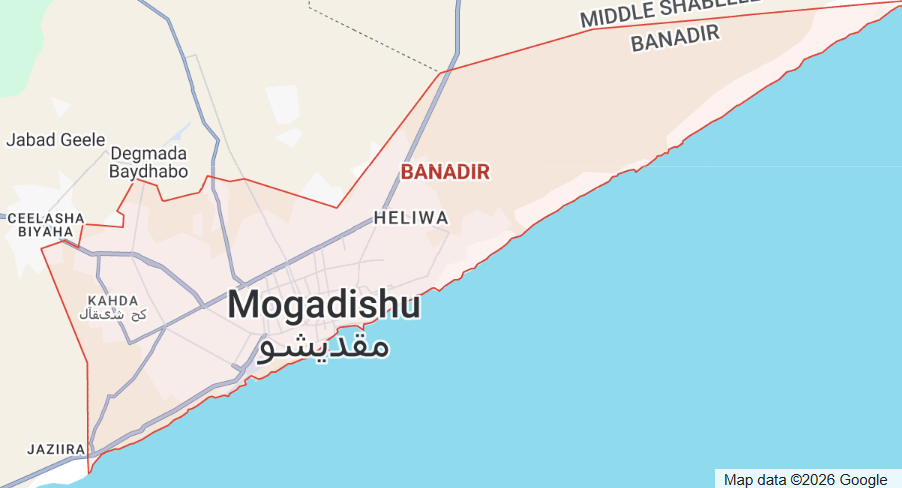

The first addressed the proposed overall architecture of federal power allocation under the amended Chapter 5, tracing how Somalia moves froma transitional federal arrangement toward a defined federal order.[2]The second focused on Article 54, which had required the Federal Government (FGS) and the Federal Member States (FMSs) to negotiate the distribution of most governmental powers,and analyzed how the proposed amendment settles that long-deferred question.[3] This essay focuses on the constitutional status of Mogadishu as passed by the parliament, which the original Constitution acknowledged as the capital city while leaving its governance entirely undecided. The amendment resolves that question. This essay analyzes what it decides, what it means for the people who live there, and why the settlement it produces is neither fair nor stable.
Article 63 of the amended Constitution establishes the capital’s governing framework. It creates a capital council elected from the districts of Banadir, provides that the Mayor and deputy mayors are elected by that council, and grants Banadir representation in the Upper House equal to other regions. These provisions have the appearance of local self-governance. The substance is elsewhere. The FGS is responsible for the security and political affairs of the capital, along with any other matters that future parliamentary legislation may designate. A federal representative for capital and Banadir affairs operates within the capital’s administrative structure. The capital’s authority exists within the concurrent powers framework of amended Chapter 5 and applies only where authority has not been reserved to the federal government by the Constitution or subsequent law. Parliament must enact legislation defining the responsibilities shared between the FGS and the capital, and in doing so it determines and may later redraw the boundary between federal and local authority.
Mogadishu is not a government compound. It is a city with residents yearning to take control of their lives and need to create governance they can depend on to manage their security, protect their lands, regulate their markets, improve their roads and sanitation, and provide the hundred other functions of urban governance. The new government structure assigns none of those functions of the city is to a council the residents of the city elect. Instead, the police force operating in Mogadishu's districts, the agencies managing checkpoints, conducting arrests, and responding to crime, all answer to the FGS. When those forces act unlawfully or in ways that serve federal political interests rather than residents' interests, no local government has constitutional authority to hold them accountable. Complaints run through the same government whose agents committed the acts in question.
Federal control over 'political affairs' carries no limits. The phrase appears without definition, is not confined to federal elections or national security, and is not time-bound. In a city that is also the seat of the FGS, virtually any significant urban decision can be characterized as a political matter. The federal representative compounds this: the provision says nothing about whether this official can override the Mayor, instruct city departments, or veto council decisions. Those questions are deferred to special legislation Parliament has yet to write.
There is a further dimension the provision does not acknowledge. The Parliament that made this decision was built on the 4.5 clan-distribution formula, which allocates seats by clan identity rather than by where people actually live. Many of the members who voted on Mogadishu's fate represented clan constituencies whose interest in the capital was not residential but redistributive. They came to Parliament seeking to extend 4.5 treatment to the city, to claim a share of its governance, its land, and its revenues on clan grounds rather than on any civic connection to the place. That argument prevailed, and it prevailed because the body deciding the question was constituted in a way that guaranteed it would. Mogadishu's residents, whose claim to the city is civic and residential, were outvoted before the question reached the floor. It would have been illogical to expect any other outcome. In effect, the constitutional status of the capital was determined by a clan-allocated parliament deciding the federal status of a city whose residents are not represented territorially. Indeed, what happened in that chamber was the expected subjugation of a city's population by a parliament built on a formula that was never meant to represent them, deployed by people whose primary interest was in what Mogadishu could be made to yield, not in how its residents should be governed.
The governance structure the amendment creates compounds that injustice. Somalia spent more than a decade struggling to make two-tier federalism function. Fiscal arrangements remain unresolved. The intergovernmental mechanisms the Provisional Constitution required have not been built. The capital status provision introduces, into this environment, a governing arrangement more legally complex than anything the federation has attempted: a city with its own elected institutions, a federal government with reserved functions inside its territory, a federal representative with undefined authority, and concurrent powers conditioned on exceptions that require further legislation to determine. What is equally striking is that the structure given to Mogadishu is one designed for federal entrenchment rather than local governance: the city is positioned less as a self-governing community than as a resource to be administered from above and extracted by those with the constitutional leverage to do so. Chapter 5's schedule-based settlement was designed to give each level of government clarity about what it can and cannot do. For every other unit in the federation it provides a workable answer. For the capital, it says the concurrent powers apply except where they do not, with the exceptions defined by a law that does not exist. The capital is the one place in Somalia where the power-allocation framework produces indeterminacy rather than resolving it.
The drafters cited Abuja, Washington D.C., and Berlin to justify the federal control model. Each comparison, examined carefully, points against the conclusion drawn from it.
Nigeria did not take a living city and place it under central authority. It built a new one. Abuja was constructed on uninhabited land chosen for its neutrality, belonging to no dominant ethnic group and carrying no prior political identity. The move from Lagos was precisely a decision not to impose federal control on an existing community. Lagos retained its own government and its own residents who were never asked to accept federal supremacy. The lesson Nigeria offers is the opposite of what the drafters drew: when a federation needs a neutral capital, it builds one. Mogadishu has two million residents, deep clan-based claims to authority over its districts, a commercial infrastructure predating the federal state, and a political history that makes the question of who governs it intensely contested.
Washington D.C. was a compromise born of the American founding's specific conflicts, when tension between slaveholding and non-slaveholding states made it impossible to seat Congress permanently inside any existing state. Before Washington was built, the United States seated its federal government in Philadelphia and then New York, both major cities that remained fully part of their states, without requiring any special constitutional status. Although the Constitution authorized a federal district, the United States did not convert an existing metropolis such as New York or Philadelphia into federal territory. Instead, Congress created a new district along the Potomac using sparsely populated land ceded by Maryland and Virginia and built the capital there. The argument that a national capital must be constitutionally detached from its community was not a founding principle but a political compromise, and an incomplete one. Washington's residents have spent generations contesting their status as a civic injustice: their license plates carry the words 'Taxation Without Representation,' turning the grievance against the British monarchy that justified American independence inward against the federal government they fund without a voting voice in the Congress that governs them, a grievance that intensified as Washington's population grew and its residents increasingly mounted a political campaign for statehood. Washington is not an example Somalia should wish to follow. Mogadishu is the largest city in the nation and importing that model into a country where political grievances are already acute and institutional trust is already thin would not settle the capital question. It would deepen the wound.
Berlin did not arrive at city-state status through choice or deliberate design but through catastrophe. After the Second World War the city was divided, then physically severed, with West Berlin becoming an isolated enclave inside East Germany and sustained by an airlift. It was also governed under conditions with no parallel elsewhere in the federation, cut off from the country it nominally belonged to and surrounded on all sides by hostile territory. It’s governance structure was dictated by necessity. That unique administrative structures built over four decades of isolation were not a constitutional preference but the institutional residue of an emergency status that lasted long enough to become permanent. By reunification in 1990, dismantling Berlin's Land government was no longer practical. The constitutional status of Berlin followed institutional reality. No one chose Berlin's arrangement as a model. It is inherited from a history they did not choose. To present it as a template for Mogadishu is to mistake the product of military occupation and Cold War division for considered constitutional design.
What the drafters underweighted are the cases that most directly apply. Ottawa remains entirely within the province of Ontario, governed like any other Ontario city, with federal interests managed through law and negotiation. Bern is a full Swiss canton with no special federal claim over its security or political affairs. Vienna is a constituent Austrian state with the governing authority any other state enjoys. In none of these cases did co-locating national government and urban population require subordinating residents to central authority. These examples were available and were not followed, without explanation.
The residents of Mogadishu were not consulted. The review process held no referendum in the capital and did not ask whether residents accepted federal control of their security and political affairs or wished to live under an arrangement installing a federal representative alongside their elected Mayor. Parliament voted, and the result was imposed on two million people as constitutional fact. An elected council and Mayor are genuine achievements, and Upper House representation for Banadir is meaningful. But democracy is not only about who holds office. It is about whether those in office have authority to govern. A Mayor who cannot direct the police, cannot control political affairs, and must accommodate a representative whose powers the text does not define holds a mandate hollowed out before it is exercised.
Constitutional arrangements residents experience as unjust produce grievance, and in Somalia's political history, grievance produces conflict. The provision gives the FGS constitutional authority over Mogadishu without giving the capital's communities a basis to contest that authority. When the security mandate is exercised in ways communities regard as predatory or partisan, no local institution has constitutional standing to push back. The arrangement will also unsettle the wider federal compact. The Federal Member States that have spent years resisting federal encroachment will not read this provision as limited to the capital. They will read it as a statement of intent, and they will respond accordingly.
Article 9 of the 2012 Provisional Constitution deferred the capital question because the political consensus to resolve it did not exist. That consensus still does not exist. What replaced it was not agreement but arithmetic: a parliament built on the 4.5 formula resolved the question in the Federal Government's favor, as it was always going to, and fixed the result in constitutional text. The residents of Mogadishu, who have the most at stake, had no role or prospect in that process. The stability of a federation that depends on all its communities believing the settlement is fair has been placed at risk by a provision that satisfies those who held the votes and their constituents, sans Mogadishu residents.
Notes and References:
[1] Bashir M. Sheikh Ali, J.D., Ph.D., is a Somali American lawyer based in Nairobi. The views expressed in this analysis are his own and do not reflect those of any organization with which he may be affiliated. He can be reached at[email protected].
[3] https://hornobserver.com/articles/3602/Somalia-Article-54-and-the-Federal-Settlement-Constitutional-Authority-and-the-Politics-of-Completion
- Popular
- Rated
- Commented


04/11/2021 - 11:05:02


28/05/2024 - 15:44:10




18/08/2025 - 17:22:07

01/03/2021 - 09:00:37



Opinions
16/09/2026 - 16:11:57

15/09/2026 - 16:56:43
Politics

06/10/2026 - 18:48:48

06/10/2026 - 15:14:30
02/10/2026 - 17:35:54
Terror Watch
06/10/2026 - 21:41:19

06/10/2026 - 21:03:29
29/09/2026 - 14:38:38
Press Releases


12/10/2026 - 13:44:28

05/10/2026 - 19:10:20




Somalia: Mogadishu Governed from Above: The Constitutional Case Against the Capital Arrangement
This is the third in a series of essays examining the amendments to the Provisional Constitution. The first two essays examined the amendments as proposed, while this one analyzes the text as passed by Parliament.